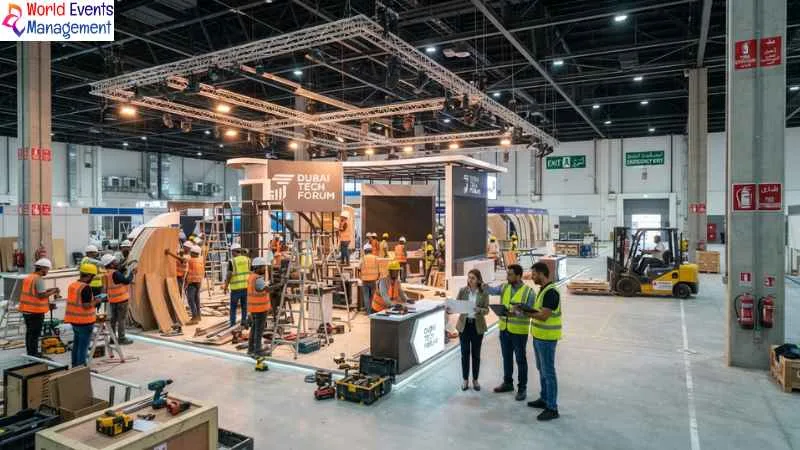
Exhibition stand design in Dubai isn't just about aesthetics — every square metre has to pass strict engineering and safety checks before a single panel goes up. Here's how compliance actually shapes better design rather than limiting it.
In one of the world's most dynamic exhibition hubs, a stand has to be visually striking and structurally sound and fully compliant with local rules — from Dubai World Trade Centre to Expo City, compliance isn't negotiable. World Events Management has spent years perfecting the balance: exhibition spaces that charm audiences while meeting every technical requirement Dubai's authorities set.
A Fast-Evolving Regulatory Landscape
Every custom stand is measured against engineering, safety and operational benchmarks — the approval process is a genuine technical validation, requiring detailed layout drawings, high-resolution 3D renderings, electrical plans with load calculations, and fire-retardant material certifications. Double-decker stands or suspended structures need additional engineering reports on top of that.
How We Build Compliance In From Day One
Compliance gets designed in from the first briefing, not bolted on afterward — we assess your objectives, space and budget, then design concepts that are engineered to standard from the outset, coordinating directly with venue technical departments and preparing every approval document ourselves. Submission deadlines at Dubai's major venues are strict, and missing them means late fees, revisions or outright rejection — our project managers keep the whole build, from fabrication through on-site execution, on schedule and within budget.
Safety Is Non-Negotiable
Dubai Civil Defence enforces stringent fire safety rules under UAE fire and life safety codes — hot work like welding needs a prior permit, fire extinguishers must stay within easy reach, emergency exits and fire points must stay visible and unobstructed, and flammable material storage is tightly controlled. Any violation can trigger an immediate stop-work order, so our supervisors monitor construction continuously and brief every on-site worker on the rules before work begins.
Regulation as a Design Opportunity
Strict rules don't stifle creativity — they're the foundation of a safe, competitive exhibition environment, and we treat them as design input rather than a constraint. Walls longer than six metres, for example, must be broken up with glass or openings to preserve sightlines and aid emergency access — a requirement our designers turn into more open, inviting layouts that draw visitors in rather than blocking them out.
Navigating Approval, By Stand Type
Modular booths need minimal documentation; custom builds go through full technical review. Double-decker stands — which add 50–100% more usable floor area — need a structural engineer, structural drawings, DWTC technical approval and a pre-event physical inspection, typically taking 2–3 weeks and an AED 1,000 fee. We manage every one of these paths so you're free to focus on the exhibition itself.

Risk Management, Training & What's Next
A stand that fails inspection loses valuable exhibition time and damages credibility, which is why we run pre-event inspections, verify fire-retardant certification and confirm electrical systems are tested before doors open — with contingency plans in place for last-minute design or schedule changes. Dubai's public safety law also now requires trained safety supervisors, alarm systems and clear signage at venues, so our on-site support extends to staff briefings and emergency response coordination throughout the event, plus safe dismantling once it ends.
Sustainability is playing a growing role too — recyclable materials, modular structures and energy-efficient lighting are increasingly standard, and we use 3D visualization and data-driven insights to test designs and catch compliance issues before construction even starts.